
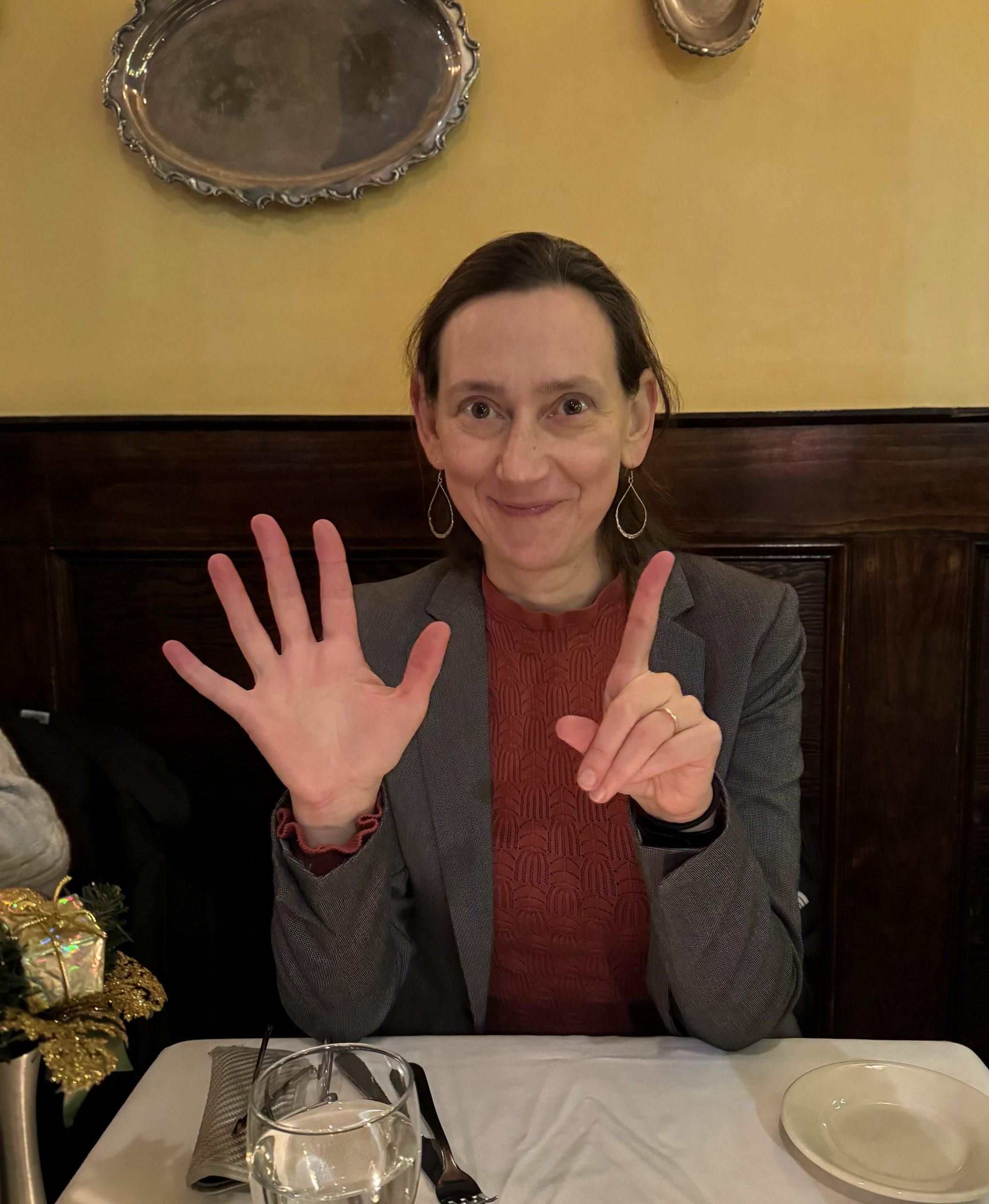

I turned 51 this week; I spent the day being very quiet, still, and slow.
This is a big year: both of my kids are now in college, I have a new book, and I’ve been, in some ways, busier than ever–and I’ve been enjoying that.
But I took the day to integrate some of that “outer” activity I’ve been doing more of with the more “inner” activity of reflection and stillness.
The relationship between our inner stillness and our outer activity is, I think, all the more important for us to notice these days when there is so much turmoil in the world.
In the spirit of inner reflection, I thought I’d share a poem from my new book, I Say the Sky. This poem comes from the middle of the book and was first published years ago in The New Yorker. It is about coming into different ways of knowing and cultivating a relationship with the self "out beyond courage and vanity" — as I say in the poem.
This is the version of the poem that appears in I Say the Sky:
Knowing
The end (of what I know) occurs not at the end,
but at the edge of the middle of things.
Toys and plastic chairs lie scattered across the lawn,
the picnic table's spread under an arching beech,
but these human signs can't speak
of the necessary shift, and even the cloud
that cuts the monotonous sky with a brilliant pink
has nothing to do with this change.
The particular, the compelling object, breaks.
And alone, in place, remains
not the common master, waving long flamboyant arms,
but a self subtler and altogether more dangerous.
Out beyond courage and vanity,
I look back into myself:
like the silver-bowled lake
or the deep, impervious dark.
The poem comes in the middle of the book, when the speaker is confronting her own trauma in her childhood: what aspects of it does she know and what doesn’t she know? What does she remember and what is in shadow? Her world, in some way, splits open.
The egoic self that had thought it had a clear, stable identity and that had blocked out what it didn’t want to know is breaking open. And in its place is a space of self reflection.
The poem, in this version, is about the main speaker–me.
But when I originally wrote the poem–almost twenty years ago now–I wasn’t thinking directly about myself; I was thinking about my mother, who had had cancer in her mid-forties.
I was imagining the ways in which my mother’s sense of herself–and her world–was split open by her diagnosis–and how she found herself alone. It seemed to me that in her cancer diagnosis, my mother was facing the solitariness of her own mortality: that ultimately we live and die alone.
I called this earlier version of the poem, “The End.”
But I’m very happy to say that that was not my mother’s end.
So I decided to change the title to “Knowing.”
When we have big life events like cancer or, in my case, confronting an old story and building a new one, there is both an end and a new beginning.
I realized when I was putting together I Say the Sky that my experience of encountering difficult aspects of life was not so different from my mother’s. So the poem became about my own encounter with myself.
One of the amazing things about poetry is that a poem can start from one narrative moment but be applied to another.
But I wanted to change the end of the poem.
In the first version of the poem, I concluded:
Out beyond courage and vanity,
I am complete, cut off
like the silver-bowled lake
or the deep, impervious dark.
At the time, it seemed to me my mother was completely cut off, in her body, in her illness. It was a difficult time in her marriage. I was about to leave for college. And when I wrote the poem, I felt her (and my own) isolation.
But when I put together I Say the Sky, I had changed: it seemed to me that that experience of being complete in oneself and cut off is itself a kind of fallacy. We always are connected to the world around us and to others.
And so I changed “I am complete, cut off” to “I look back into myself” –
That act of self-witnessing suggests that even being with the self is a way of being connected, of having different dimensions. We can be both the observer and the observed and engage in a dialogue and relationship with ourselves.
When we get beyond ego and enter this state beyond simple knowing, beyond simple fear, we can enter into the silver-bowled container of the lake and the deep darkness of the night with greater awareness, less fear, and more presence. An image that was, for me, at first more scary became, over time, more capacious, more welcoming.
It was so powerful to revise the poem because I felt as if the poem itself had been leading me in this spiritual evolution: how do we confront really challenging things? What do we make of our supposed “aloneness”?
For me, the answer changed over time–so the poem changed with it.
One of the secrets behind I Say the Sky is that although most of the poems were written relatively recently, throughout the book, I interspersed poems I’d written in earlier parts of my life. When I’ve asked readers to guess which poems are new and which ones are old, most of the time readers don’t know.
But it was very meaningful for me to integrate so many parts of my life into this book and to update earlier poems to reflect my understanding today.
Who knows: in another twenty years, I might want to update them again.
I’d love to share the book with you–and others.
I Say the Sky is available early. The official publication date is January 16, 2024, but if you’re in North America and order it now, it will come in time for the holidays. It makes a great gift for friends and family. The poems are finely crafted and also accessible. You can order it from Amazon, the Press, or your local bookstore.
And for every book you buy (for yourself or others), you (or the recipient) receives FREE entry for my I Say the Sky 7-Day Meditation and Writing Challenge–a fun way to jump into meditating and writing for the new year (without purchase of the book, the challenge costs $30). Sign up here.
with love and gratitude,
Nadia
“at the edge of the middle of things” – this phrase will stay with me – thank you. Just discovered your work and feel like I’ve met a kindred spirit.